
On-Page SEO
E-E-A-T Audit with Codex: Score and Fix Content Quality
Run an E-E-A-T audit with Codex: score experience, expertise, authority and trust on any URL, then add bylines, dates and author markup in your code.
An E-E-A-T audit with Codex measures how much trust a page earns, judged on the four qualities Google's quality raters look for, and then lets Codex fix the structural gaps in your own code. With RankCue's Codex SEO kit, the audit is one command, $seo content <url>, which returns a content quality score out of 100, a per-factor breakdown, an AI citation readiness score and a list of fixes. This guide explains what E-E-A-T means, how the command works, how to read the report, and which fixes Codex can make for you and which only you can supply.
Key takeaways
$seo contentstarts with Google's Who, How and Why questions, then scores the four E-E-A-T factors, with trustworthiness weighted highest.- It scores the main content only, after stripping navigation, footers and cookie banners, so boilerplate doesn't blur the result.
- Beyond E-E-A-T it checks coverage against page-type word floors, readability, keyword use, links, freshness and markers of low-quality AI content.
- Codex can add bylines, author pages, dates and Person markup in your templates. Real experience and credentials have to come from you.
- E-E-A-T is a framework for judging quality, not a single ranking score. The audit shows where a page looks weak to a careful reader.
The content command at a glance
| Item | Details |
|---|---|
| Command | $seo content <url> |
| What you give it | The URL of a live page, or the page text if it sits behind a login |
| What Codex reads | The page HTML, rendered in a headless browser only when it detects a JavaScript app shell, reduced to its main content |
| What you get back | A content quality score, an E-E-A-T breakdown, an AI citation readiness score, issues and recommendations |
| Needs | Internet access for the fetch; an optional DataForSEO account for keyword volume and difficulty |
| Best for | Health, finance and other high-stakes pages, author-led blogs, and pages that lost ground after a core update |
What is E-E-A-T, and why does it matter?
The acronym covers four qualities: the creator's first-hand Experience, their subject Expertise, the Authoritativeness of the creator or site, and the page's overall Trustworthiness. It comes from the guidelines Google writes for its human quality raters, who grade sample results so Google can test its ranking systems. Rater grades don't move any single page, but the guidelines describe the kind of result Google's systems try to favor. Trust sits at the center: a page can show deep expertise and still fail if readers have no reason to believe it.
Start with Who, How and Why
Before scoring anything, the skill runs the three questions from Google's guide to creating helpful, people-first content:
| Question | What the skill looks for |
|---|---|
| Who created it? | A named author the reader can see, a page about that person, and qualifications that fit the topic |
| How was it created? | A note on how the page was made when readers would want one, especially if AI helped, backed by first-hand evidence |
| Why does it exist? | The page is there to help people, not to collect search clicks |
The Why question exposes habits that hurt sites slowly: moving into a topic the team knows nothing about, republishing old pages just to look current, and stretching text to hit a length. Google folded its helpful content system into its core ranking systems, so helpfulness is now judged continuously rather than in separate updates. When all three answers are weak, the skill treats the page as at risk.
The four factors
- Experience: the author has actually done it. Signs include first-hand testing, case studies with outcomes, process write-ups, original data, and photos or video taken in real use.
- Expertise: the author knows the field. Signs include fitting qualifications and background, depth pitched at the right level, and claims backed by sources.
- Authoritativeness: others vouch for the author or site. Signs include links and citations from respected sources, brand mentions, and work published in known outlets.
- Trustworthiness: the site is honest and safe. Signs include a way to reach a real business at a real address, privacy and terms pages, customer reviews, dates and visible corrections, and HTTPS.
YMYL, short for "your money or your life", covers topics where bad advice can hurt someone: health, money, legal questions and safety. The bar is highest there, and the skill treats a missing author on a YMYL page as a serious gap.
How the factors are weighted
The content reviewer that does the scoring doesn't treat the factors equally.
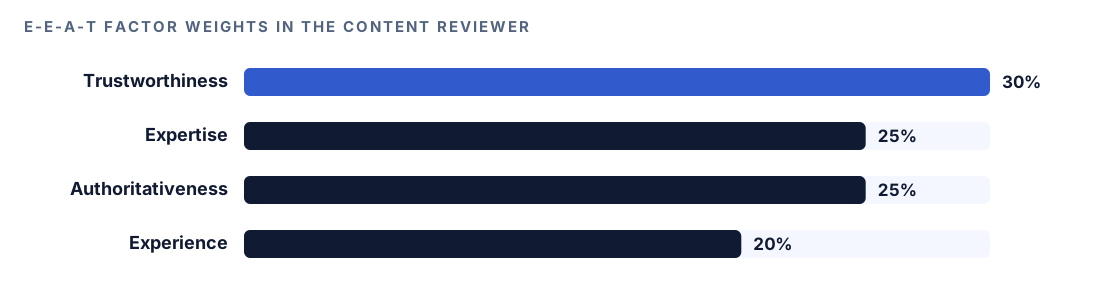
Trustworthiness carries 30%, expertise and authoritativeness 25% each, and experience 20%. In practice, a page with no contact route or dates loses more than a page that lacks a personal anecdote.
How the content command runs inside Codex
Type $seo content with a URL in a Codex task and the skill works through the same sequence each time.
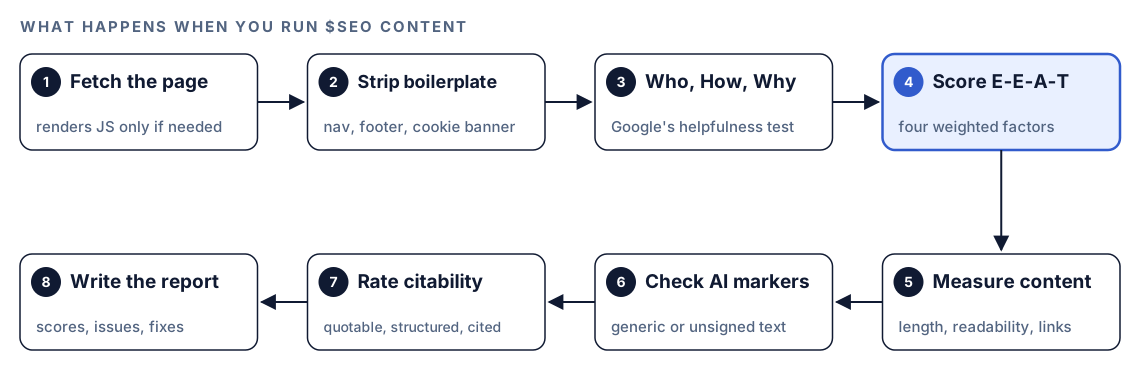
- Fetch the page. Codex downloads the HTML and only starts a headless browser if the page looks like a JavaScript app shell.
- Strip boilerplate. It extracts the main content and the publication date, dropping navigation, footers and cookie banners.
- Ask Who, How and Why. It looks for the author, the process and the purpose.
- Score E-E-A-T. Each factor gets a score with the signals behind it.
- Measure the content. Length against the page-type floor, readability, keyword use, structure and links.
- Check AI markers. It flags signs of low-quality generated content.
- Rate citability. It judges how easily an AI answer engine could quote and attribute the page.
- Write the report. Scores, issues and recommendations come back in a fixed format.
Step 2 matters more than it looks. Scoring a whole page means a long footer or mega-menu can swamp the article, so an author bio inside the post gets diluted. Scoring the extracted main text keeps the focus on what the reader came for. The same reviewer also runs as one specialist inside a full $seo audit.
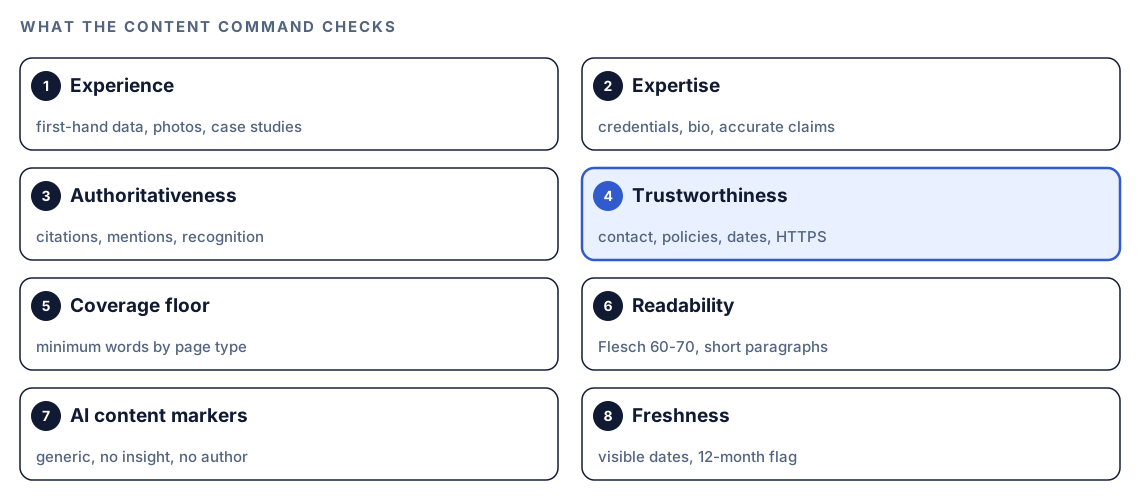
What Codex checks beyond the four factors
Coverage floors
Each page type has a minimum length in the skill: homepages 500 words, service pages 800, blog posts 1,500, product pages 300 and up (400 and up when the product is complex), and location pages 500-600. These floors check coverage, not effort. Google has stated that length alone doesn't help a page rank, and a short page that fully answers the question beats a long one that circles it.
Readability
The target is a Flesch Reading Ease between 60 and 70, which suits most general readers, with sentences averaging 15-20 words and paragraphs of two to four sentences. Google has said it doesn't rank pages on readability formulas, so the skill treats the score as a reader-comfort check, not an SEO lever.
Keywords, structure and links
It wants the main keyword in the title, in the H1 and early in the opening 100 words, at a natural density of 1-3% and never stuffed. Headings should step down in order, sections should be easy to scan, and long pages should have a table of contents. For links, it expects three to five relevant internal links for every 1,000 words, anchors that describe the target, no orphaned pages, and a sensible number of citations to strong sources.
AI content and freshness
AI-assisted content is fine when it shows real E-E-A-T, adds unique value and has human editing. The skill flags the weak kind: vague, interchangeable sentences, nothing a reader couldn't find elsewhere, one template repeated page after page, no named author, and mistakes of fact. On freshness, it wants a visible publication date, an updated date when the page has been revised, and it flags fast-moving topics left untouched for more than 12 months.
AI citation readiness
The second score measures how quotable the page is for AI answers: clear statements with facts, answer-first sections, a clean H1 to H2 to H3 flow, tables for comparisons, structured data, and visible sources. The skill treats this as normal SEO applied to AI search surfaces, not a separate discipline. Our generative engine optimization guide goes further.
Run it in Codex, step by step
- Install the kit from the install section, restart Codex, and open a new task in your site's project folder. See installing SEO skills in Codex for details.
- Check your permission mode. The command fetches a live page, so depending on your mode, Codex may ask before it uses the internet. Approve it for the site you're auditing.
- Run the audit:
$seo content https://example.com/guides/fixed-rate-mortgage- Or ask in plain language, and Codex picks the skill from its description:
Run an E-E-A-T check on https://example.com/guides/fixed-rate-mortgage. I want to know what makes it look untrustworthy to a careful reader.- For gated or paywalled pages, the skill reports that the content isn't public and analyzes only the visible portion, such as the meta tags. If fewer than 100 words come back, it flags the page as possibly JavaScript-rendered or gated. In both cases, paste the article text into the task or point Codex at the source file.
- If DataForSEO tools are connected in your Codex setup, the skill adds keyword volume, difficulty, intent and a content analysis summary. That needs your own DataForSEO account, and its pricing applies.
Reading the report
The report follows the same layout every time:
### Content Quality Score: XX/100

### E-E-A-T Breakdown
| Factor | Score | Key Signals |
|--------|-------|-------------|
| Experience | XX | [first-hand signals found or missing] |
| Expertise | XX | [author credentials, accuracy] |
| Authoritativeness | XX | [citations, mentions] |
| Trustworthiness | XX | [contact, policies, dates, HTTPS] |

### AI Citation Readiness: XX/100

### Issues Found
- [issue and where it appears]

### Recommendations
- [specific fix]
Prioritize in this order:
- Trust gaps. No author, no dates, no contact route. They carry the most weight and are usually template fixes.
- Accuracy. Unsourced or wrong claims hurt trust and expertise together.
- Experience. Thin first-hand evidence. Only your team can supply it.
- Coverage and readability. Expand thin sections and break up dense ones.
- Citation readiness. Answer-first openings and tables, once the basics are solid.
Apply the fixes with Codex
Many trust signals live in templates, not in individual articles. A missing byline or updated date on one post is usually missing on all of them, and Codex can fix the template once. Before:
<article>
  <h1>How to Choose a Fixed-Rate Mortgage</h1>
  <p>Choosing a mortgage term starts with...</p>
After:
<article>
  <h1>How to Choose a Fixed-Rate Mortgage</h1>
  <p class="byline">By <a href="/authors/jane-doe">Jane Doe</a>, mortgage advisor. Updated <time datetime="2026-10-01">October 1, 2026</time></p>
  <p>Choosing a mortgage term starts with...</p>
Pair it with markup that names the author as an entity:
{
  "@context": "https://schema.org",
  "@type": "Article",
  "headline": "How to Choose a Fixed-Rate Mortgage",
  "datePublished": "2025-03-12",
  "dateModified": "2026-10-01",
  "author": {
    "@type": "Person",
    "name": "Jane Doe",
    "url": "https://example.com/authors/jane-doe",
    "jobTitle": "Mortgage Advisor"
  }
}
Then hand Codex the job:
Use the $seo content report for /guides/fixed-rate-mortgage. In the article template, add a visible byline linking to the author page, an updated date from each post's front matter, and Article JSON-LD with an author Person. Read names and credentials from the author data in this repo; never invent them, and ask me if they're missing. Show me the diff, then run the build.Draw the line clearly. Codex can wire up bylines, author pages, dates, contact links and markup. It should not write a personal anecdote, a test result or a credential nobody has, because invented experience is exactly what the audit is meant to catch. For the content itself, $seo flow optimize and $seo flow win offer structured prompts for E-E-A-T improvement and conversion, covered in our guide to the FLOW framework in Codex.
Make it repeatable
Trust signals drift as templates change and authors leave. A small codex exec loop re-audits your most sensitive pages on a schedule and saves one report per page:
mkdir -p reports
while read -r url; do
  name=$(basename "$url")
  codex exec "Run \$seo content $url. Put missing trust signals first, then the full report." -o "reports/eeat-$name.md"
done < ymyl-pages.txt
codex exec runs Codex without the interactive interface, and -o writes the final message to a file. It expects a Git repository, so commit the reports and compare each run with the last. The command fetches live pages, so make sure your sandbox and permission setup allows the network access it needs. Our guide to automating SEO checks with codex exec covers CI.
Without the skill: a plain Codex prompt
You can get a useful first pass with no kit installed:
Fetch https://example.com/guides/fixed-rate-mortgage and read only the main article. Tell me who wrote it, how it was made, and why it exists. Then list evidence for experience, expertise, authoritativeness and trustworthiness, quoting the page. Flag missing bylines, dates, contact details, sources, and any generic or unsupported claims.What the skill adds is consistency: the same weighted scoring, page-type floors, AI-content markers and report format on every page, so scores are comparable across a site and over time.
Pitfalls to avoid
- Treating E-E-A-T as a single number to push up. The score points at weaknesses; it isn't what Google ranks.
- Inventing experience. A made-up anecdote is worse than none.
- Adding author boxes with no substance. A name without relevant background adds little.
- Padding to reach the word floor. Floors measure coverage, not effort.
- Fixing one article when the template is the problem.
- Ignoring the footer. Contact details, policies and HTTPS still matter even though the score focuses on main content.
Keep going
- On-page SEO analysis with Codex checks titles, headings, meta tags, images and schema on the same URL.
- Score a blog draft before you publish catches quality problems before a page goes live.
- The FLOW framework in Codex turns audit findings into structured rewrites.
- Every Codex SEO and Codex Blog command lists the full kits.
FAQ
What do the letters in E-E-A-T mean?
The first E is for Experience and the second for Expertise. A is for Authoritativeness and T is for Trustworthiness. Together they form the lens Google's quality raters use to judge whether a page and its creator deserve trust, with trust as the core of it.
Does E-E-A-T directly affect rankings?
Not as one measurable score. Google describes it as a framework its raters use to evaluate results, and its systems look for signals that line up with it. Improving E-E-A-T means improving the real signals: authors, sources, evidence and transparency.
How can I audit E-E-A-T across my site?
Start with your most sensitive pages and ask Google's Who, How and Why questions of each, then look for evidence behind every factor. In Codex, $seo content <url> does this for you and returns scores and fixes for every factor.
Is AI-assisted content a problem for E-E-A-T?
Not when a person edits it, it adds something original, its claims are accurate and sourced, and a responsible author is named. Generic, unsigned text with no first-hand evidence is what the skill flags.
Can Codex fix E-E-A-T problems automatically?
It can fix the structural ones: bylines, author pages, dates, contact links and Person markup in your templates, with a diff you review before anything ships. It can't supply real experience or credentials; those have to come from your team.